
Heathlands CofE Primary School
Collective Worship
Collective Worship
At Heathlands, our Collective Worship Policy strengthens and supports the Christian ethos of our school, explores our vision Helping Everyone Shine their Light and the associated values we derive from them Trust, Respect, Enjoyment, Courage, Kindness. Our worship reflects the variety of traditions found in the Church of England and will recognise and follow the Christian liturgical year.
Worship at Heathlands is not simply a statutory duty. The Christian act of collective worship is the heartbeat of our school, central to our ethos and is supported by all staff and governors. It makes an important contribution to the overall spiritual, moral, social and cultural development of the whole school community.
The aims and purpose of Collective Worship as defined by the Education Reform Act 1988 are as follows:
- To provide an opportunity for the children to worship God.
- To enable children to consider spiritual and moral issues.
- To enable children to explore their own beliefs.
- To encourage participation and response
- To develop in children a sense of community spirit
- To promote a common ethos with shared values and to reinforce positive attitudes
Principles of collective worship
Each adult and pupil will experience worship that is truly welcoming, inclusive and exemplifying the principles of Christian hospitality (see Church of England’s Collective Worship Guidance).[1] Collective worship therefore will be:
- Inclusive – Our acts of worship recognise that pupils and staff come from homes of different faith backgrounds as well as no faith backgrounds, so it will be inclusive of, and fully accessible to all. Care will be taken to ensure that language used by those facilitating worship avoids assuming faith of those participating, listening or watching.
- Invitational – In our acts of worship, there is no compulsion to ‘do anything’. Rather, worship will provide the opportunity to engage whilst allowing the freedom of those of different faiths and those who profess no religious faith to be present and to engage with integrity. Pupils and adults will only be invited to pray and sing if they wish to do so.
- Inspiring – By asking and discussing big questions about who we are and what we do in worship we hope to motivate pupils and adults into action. There will be opportunities to think, reflect and ponder on their and the wider community’s behaviour and actions.
At Heathlands C of E Primary school, we aim to provide a worship space which is attractive and well prepared with appropriate thought having been given to colour, space, seating, ambience and music.
We foster close links with St Mary’s Church, involving the Reverend Heather and the Open Book group, in leading collective worship and providing coherence between worship in church and Heathlands and visit at least four times per year as part of the Christian calendar. We hold regular Prayer Spaces that involve our school and the wider community, as well as a Year 6 ‘Retreat’ focusing on transition.
We recognise that different members of our school community spiritually reflect in different ways. Music, story, silence, prayer, drama and other approaches are incorporated within a varied collective worship offer.
Each Act of Worship will contain the following elements:
- A welcome to the school community, using a combination of a liturgical greeting, lighting of a candle, with music or with a visual display. A visual focus (e.g. a lit candle, an image or some other element that allows children to focus on the worship element) This element of the Act of Worship is to awaken the children.
- Engagement of the pupils and staff by sharing the core message. This may be through song / hymn, bible reading, drama, a quiz, pupil activity etc… All material is presented in an appealing way and where possible will make use of visual aids and artefacts to help children remember the message. This is followed by an opportunity to respond and reflect upon this message and the impact that it has on their lives today. This may be through prayer, quiet reflection, activity, poem, song or discussion.
- The use of ‘windows, mirrors and doors’ develops our sense of spirituality, supporting those involved to ‘look out’ (windows), ‘look within (mirrors) and ‘look ahead’ (doors).
- We conclude our Collective Worship by ’Sending’ out. We close our worship through one or more of the following elements – a final message, Bible verse, a challenge, song, prayer, music, liturgy, blowing out of the candle. The messages in our Collective Worship are followed up on in classes or in further acts of Collective Worship. It is this part which defines the gathering as an Act of Worship rather than an assembly.
As a school community, we enjoy our acts of worship. We are proud to be members of St Mary’s Church, and we appreciate opportunities to come together to worship God and to celebrate our achievements.
We also aim to ensure children experience elements of the Anglican tradition. Special services are held in the local church and local clergy are invited into school to lead worship. Through our structured approach to running whole-school worship children begin to have an understanding of Anglican prayer and the liturgy. In order to further develop the connection between worship in school and that of the Church of England we use the cycle of liturgical colours on our Worship table at the front of the hall.
|
Purple |
Advent and from Ash Wednesday to the day before Palm Sunday. |
|
White or Gold |
Christmas Day to Candlemas (early February), Easter Day to the Eve of Pentecost, Trinity Sunday, All Saints’ Day (1st November). |
|
Red |
Holy Week, Feast of Pentecost, between All Saints’ Day and the First Sunday of Advent |
|
Green |
The day after Candlemas (early February) to Shrove Tuesday. The day after Pentecost (mid to late May) to All Saints’ Day (1st November) |
Within our worship we recognise, affirm and celebrate:
- Our school’s core Christian values: Trust, Respect, Enjoyment, Courage and Kindness
- Our school’s vision: Helping Everyone to Shine their light
- To develop understanding of the theological underpinning: You are the light of the world. A city on a hill cannot be hidden. Shine your light before all that they may see your works and then praise your Father in heaven.’ Matthew 5v1416
- An appreciation of our world
- The highest achievement of which we are capable
- A recognition of the interdependence of human beings – especially those in need
- Our belief in God as Creator, Jesus and the Holy Spirit
Worship Areas - Class 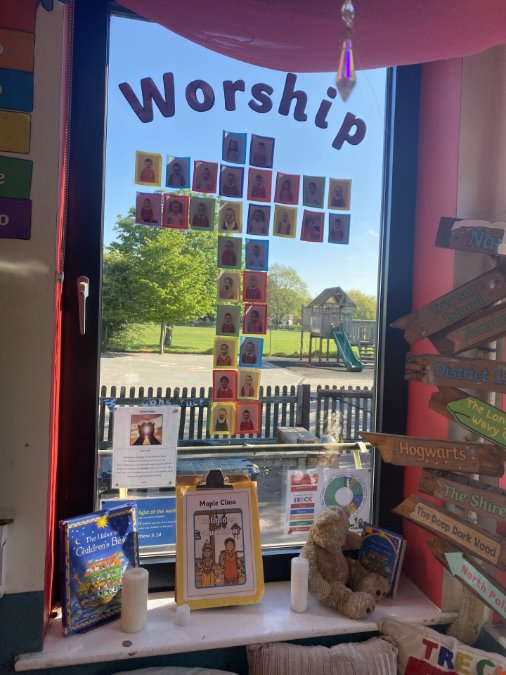
Each classroom space has a dedicated Worship area, which supports our daily collective worship and provides a calm and reflective space.
The area is a place where children can:
-
Pause and reflect
-
Pray in their own way
-
Explore Christian values and teachings
-
Find stillness in a busy school day
The Worship area is a focus table/area with a cross and a bible that children can access reflecting ‘Helping everyone Shine their light’ (using imagery, symbols or language). It includes:
-
Seasonal colours linked to the Liturgical calendar
-
Class created cross
-
Prayer and reflection resources
-
Pupil contributions – artwork, class prayer book, reflections from collective worship
-
Quiet space that children can access for personal thought and mindfulness
-
Collective worship candle and resources may be stored here
-
Link to the current Christian core value being discussed in Collective worship
Worship Council
The Worship Council gives the children of Heathlands a voice in how worship is carried out at school and ensure it has a positive impact on everyone. The Council meet regularly to discuss what is going well with our worship as well as what could be improved. Along with the Worship Team, they have taken a more active role in the Acts of Worship, especially at the church. In school, they have nurtured a prayer tree as a reflective space and are currently in discussions over the creation of both outdoor and indoor permanent prayer and reflection spaces.
Each half-term the worship councillors reflect with their classes on the current core value and the impact it has had on them as individuals.
Pupils reflect on the Acts of Collective Worship and pupil voice is shared to develop Collective Worship moving forwards.
Prayer Spaces
Children and young people are innately curious about life. Growing up raises lots of questions, some to do with their experience, both the good and the bad, and some to do with their sense of wonder at the universe we live in and whether there’s more to life than meets the eye.
Prayer spaces in schools enable children and young people, of all faiths and none, to explore these life questions, spirituality and faith in a safe, creative and interactive way.
Our prayer spaces are run with the support of St Marys Church and CYO, on a two year rolling programme- featuring Remembrance, Advent - what are we preparing for?, Who am I - Advent.